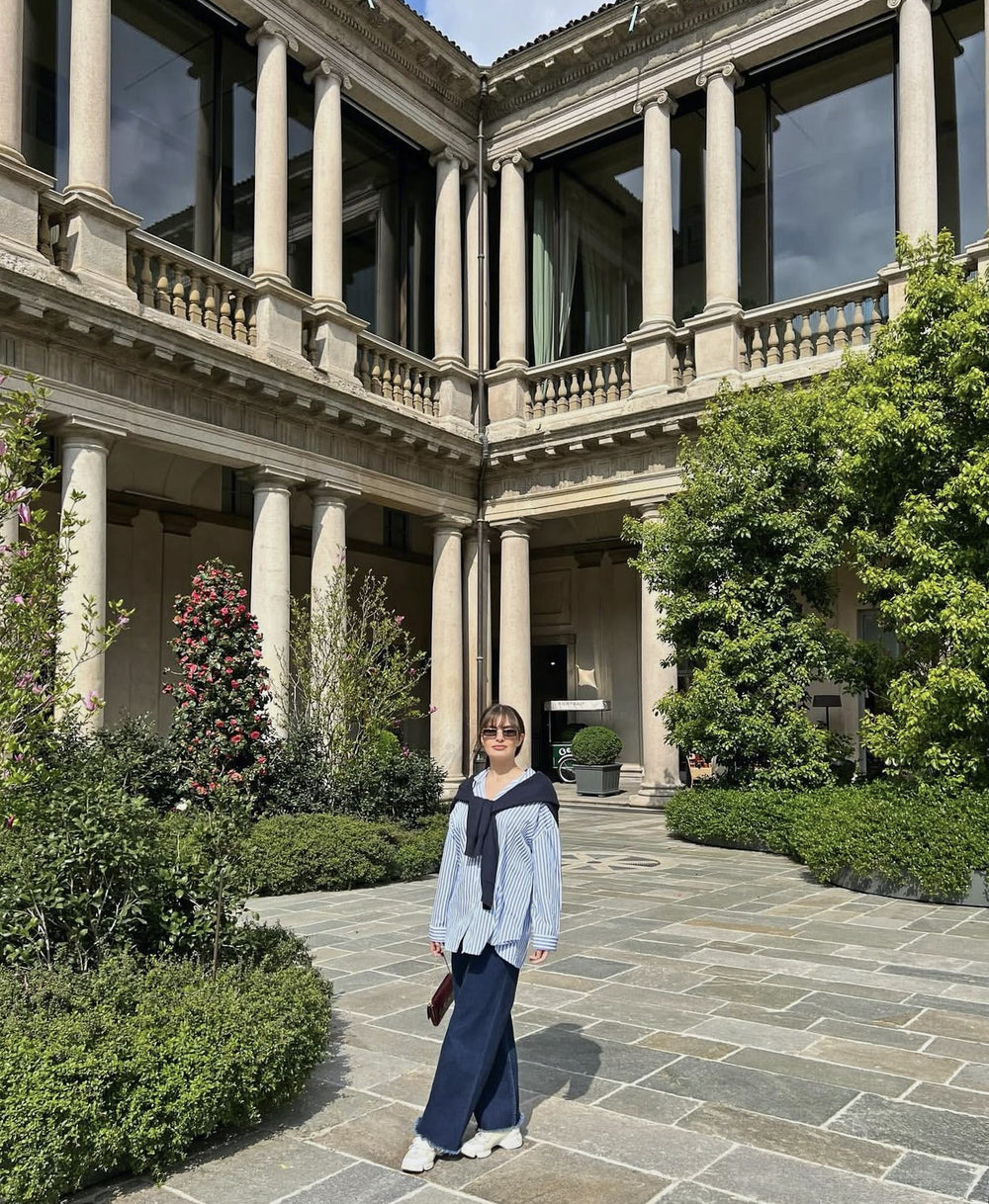


Milan’s history is not always immediately legible, a fact often mistaken for absence. Unlike cities where the past announces itself through sweeping views or monumental palaces, Milan’s layers must be sought out. Many of the places that reveal something concrete and true about the city—its history, values, and ways of living—are not immediately apparent, either online or at street level. They emerge instead through interiors, private collections, courtyards, and rooms assembled quietly over generations. As a result, many of Milan’s most important cultural sites were never conceived as museums at all, but as homes, palazzi, or working civic spaces shaped by use.
This is evident even in places as emblematic as Teatro alla Scala. From the outside, its façade is restrained, especially when compared to the overt theatricality of Paris or Vienna. Inside, however, it opens into a richly ornamented world of red velvet, gold, and layered history dating back to the late eighteenth century. Crucially, La Scala is not preserved as a museum: it remains a working theater, still used daily by musicians, dancers, and performers. Its beauty is revealed through function, not presentation.
The same logic applies to many of Milan’s museums and historic spaces. Places like Casa Museo Boschi di Stefano, Museo Poldi Pezzoli, and the Bagatti Valsecchi Museum were homes first, shaped by collectors, patrons, and families who believed that art belonged in daily life rather than in isolated institutions.

What follows is a curated selection of cultural and historic sites that reveal how Milan’s history has been lived, collected, and continuously inhabited across centuries.
The Bagatti Valsecchi Museum is perhaps the most deliberate expression of this mindset: a near-total reconstruction of a Neo-Renaissance noble residence. Original furniture, architectural fragments, and decorative arts were assembled to evoke the atmosphere of a fifteenth-century Lombard palazzo. By combining an idealized Renaissance aesthetic with the most advanced technologies of the late nineteenth century—heating, running water, and electricity—the family showed that comfort, innovation, and historical taste could coexist without contradiction. By contrast, Casa Museo Boschi di Stefano presents a more modern, twentieth-century idea of living with art. Housed in a private apartment, its collection of Italian modernism is arranged as it was originally inhabited, with paintings and sculptures integrated into domestic rooms, resulting in a home that feels closer to a private gallery.
Museo Poldi Pezzoli approaches domestic collecting from a more classical, palatial tradition. Housed in what was once a private aristocratic residence, the museum brings together an exceptional collection of antique arms and armor alongside paintings from the Lombard, Venetian, and Tuscan Renaissance, including works of significant historical importance. The interiors unfold as a sequence of richly articulated rooms, the Sala d’Armi, the Salone Dorato, the Studiolo Dantesco, and the Sala del Camino, each conceived to evoke a specific cultural and historical atmosphere.
Villa Necchi Campiglio captures a very different moment: interwar Milan, shaped by industrial wealth and modern living. Designed by Piero Portaluppi in the 1930s, the villa combines rationalist architecture with refined interiors, a private garden, and amenities that were advanced for their time. It reveals how architecture, design, and social life converged in a period when modernity was quietly redefining taste behind closed doors.


Other sites trace earlier chapters of the city’s history. Palazzo Clerici reflects the city’s Baroque era and the power of its aristocratic patronage. Once the residence of one of Milan’s most influential families, the palazzo is best known for its grand piano nobile and the monumental ceiling fresco by Giambattista Tiepolo. It offers a glimpse into how culture functioned as representation and authority in eighteenth-century Milan. While, at the heart of the city, Castello Sforzesco anchors Milan’s Renaissance and ducal past. Originally a fortress and later transformed into a courtly residence under the Sforza dynasty, the castle today contains multiple museums, from sculpture and decorative arts to ancient musical instruments. Its layered architecture—defensive walls, courtyards, and ceremonial spaces—mirrors Milan’s shift from medieval stronghold to Renaissance capital.
Going further back, the Crypt of San Sepolcro exposes Milan’s Roman foundations beneath the contemporary city. Set below street level, the crypt preserves ancient paving and sacred space once aligned with the Roman forum, offering a rare, physical encounter with the city’s earliest urban layer. Nearby, the Santuario di San Bernardino reflects a more devotional and symbolic relationship to history. Its interior, adorned with human bones arranged into decorative patterns, speaks to a distinctly Lombard approach to memory, faith, and mortality—where history is not aestheticized, but ritualized.